11 Aug 2026 · WhatsApp
Donor–recipient matching
Sheet-like registry for new patients, hard clinical match rules first, then simple foresight on complications — not a complex Western-style AI.
What they asked for
- Google Sheet–like app — add every new patient into structured fields.
- Match donor ↔ recipient — is this pair appropriate?
- Suitability — is the recipient suitable for surgery?
- Anticipated complications — practical foresight for legal / financial / medical decisions.
- Simplify — remove resident paperwork burden; patient → application interface.
Keep it simple (“E=MC²”). Sapana’s protocol simplification already enabled POD‑3 discharge — AI should amplify that, not add complexity.
Hard rules (stated)
| Rule | Threshold |
|---|---|
| GRWR (graft weight / recipient weight) | > 0.65 |
| Donor remnant (for ~10% steatosis case) | ≥ 30% remnant |
| Recipient age | < 75 years |
| Recipient comorbidities | No major comorbidities |
Software must fail closed on these before any AI suggestion.
What “suitable” means
- Outcome label: patient going home from hospital (not 90‑day / 1‑year Western endpoints as the primary definition).
- Decision order in India (stated): Legal → Financial → Medical.
- HLA Class I/II & crossmatch: legal proof, not a medical match driver — intentionally absent from clinical sheets.
- Rejected evaluations: no historical rejected-case dataset available to train “unsuitable.”
Recipient evaluation checklist
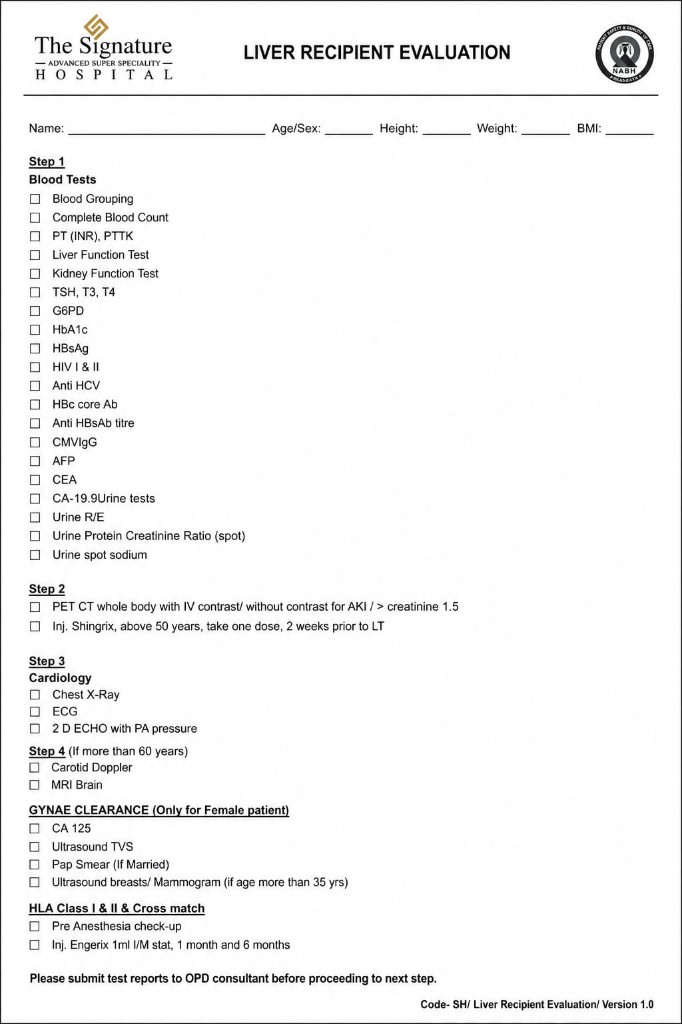
Source: Signature Advanced Super Speciality Hospital — LIVER RECIPIENT EVALUATION (Code SH / Version 1.0). Demographics: Name, Age/Sex, Height, Weight, BMI.
Step 1 — Labs
Blood group, CBC, PT(INR)/PTTK, LFT, KFT, TSH/T3/T4, G6PD, HbA1c; viral markers (HBsAg, HIV, Anti‑HCV, HBcAb, Anti‑HBs titre, CMV IgG); tumor markers (AFP, CEA, CA‑19.9); urine R/E, PCR spot, spot Na.
Step 2 — Imaging & immunization
PET‑CT whole body (no contrast if AKI / Cr > 1.5). Shingrix if age > 50 (one dose ≥2 weeks pre‑LT).
Step 3 — Cardiology
CXR, ECG, 2D Echo with PA pressure.
Step 4 — If age > 60
Carotid Doppler, MRI brain.
Gynae clearance (female)
CA‑125, TVS USG, Pap (if married), breast USG / mammogram if age > 35.
Also
HLA I/II & crossmatch (legal), PAC, Engerix schedule (stat / 1 mo / 6 mo). Reports to OPD consultant before next step.
Historical data (local only)
Confidential. Large Apollo/CLBS recipient + donor workbooks were shared in the group. They stay on the local machine only — not uploaded here. Wiki uses column themes and stated rules, never row-level patient data.
- Recipient sheet: demographics, etiology, scores (CTP/MELD), labs, imaging, graft (GRWR, graft type/wt), intraoperative, complications, outcome / survival / follow-up.
- Donor sheet: anthropometrics, steatosis / remnant %, anatomy, labs by POD, complications, outcome.
What to build first
- Sheet-like intake for new recipient + donor (mirror evaluation checklist fields).
- Calculator: GRWR, remnant %, age < 75, major-comorbidity flag → pass / fail with reasons.
- Optional: complication foresight as read-only suggestions from historical patterns — clinician decides.
- Do not invent rejected-case AI; do not treat HLA as medical match.
Working demo (local): C:\dev\CC May\rounds\clbs-match — run npm run dev. Sheet + hard-rule match + hints. WhatsApp questions: ASK_SELVA.txt in that folder.